
Home solar
Grid-tied home solar solutions
The simplest and most affordable way to cut your home electricity bill. Here are the pros and cons of a grid-tied system, and when a hybrid makes more sense.
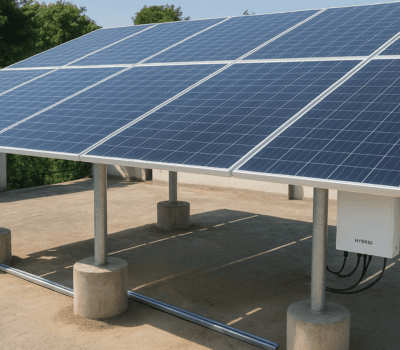
Further factors to ponder regarding solar power systems.
The most commonly observed type of residential solar solution, grid-tied home solar systems operate without batteries. These systems are both cost-effective and straightforward to design and install, as they consist of minimal components and are user-friendly, making them highly favored.
However, the absence of a battery poses a limitation, as homeowners cannot store excess solar power. Stored energy serves crucial purposes during emergencies or blackouts, as well as during periods when solar panels are inactive, such as nighttime. Without a battery, the primary backup source remains the local grid.
Excess electricity generated is typically directed back to the grid, and when needed, homeowners draw power from the grid instead of relying on a battery. Net metering proves beneficial in this setup, allowing homeowners to receive bill credits for surplus power sent to the grid, which can be utilized to purchase power when solar production is insufficient.
In the event of a grid outage, users of grid-tied home solar systems will experience power loss. To ensure safety, inverters automatically disconnect from the utility grid when power outages occur.
Advantages of grid-tied residential solar power systems
- This solar power system is the most cost-effective option.
- Installation process is very easy
- Financial incentives such as net metering can be utilized.
- Utility grid is used as a backup when solar power is less.
Cons of grid-tied residential solar power systems
- Your reliance is on grid power; once it's unavailable, the solar power system also shuts down, regardless of sunlight availability.
- They may be subject to utility fees.
- Payment for surplus energy sent to the grid may not be provided at the full retail rate.
Make an informed choice
On-grid, off-grid or hybrid?
System type decides how batteries are used, what happens in a power cut and what you invest up front.
| Feature | On-grid | Off-grid | Hybrid |
|---|---|---|---|
| Grid connection | Required | Not needed | Connected |
| Battery storage | Not used | Required | Included |
| Power during outages | No (shuts down for safety) | Yes, from batteries | Yes, for selected loads |
| Net metering | Where DISCOM allows | Not applicable | Where DISCOM allows |
| Upfront cost | Lowest | Highest | Medium to high |
| Best for | Bill savings with stable grid | Remote sites without grid | Savings plus backup |
Links: grid-tied, off-grid and hybrid systems explained.
FAQs
Frequently asked questions
What is a hybrid solar system?
A hybrid solar system combines solar panels, a hybrid inverter, battery storage and a grid connection. Solar powers your loads during the day, surplus energy charges the batteries, and the grid tops up whenever solar and batteries are not enough. When the grid fails, the inverter can switch selected loads to battery backup.
Is a hybrid solar system the same as an on-grid system?
No. A standard on-grid system has no batteries and shuts down during a power cut for safety. A hybrid system adds batteries and an inverter that can keep chosen circuits running when the grid is down, while still working with the grid the rest of the time.
Will my whole building run during a power cut?
Not automatically. What stays on, and for how long, depends on battery capacity, inverter rating and which circuits are wired to the backup side. We list your essential loads first, such as lights, fans, Wi-Fi, a refrigerator or a borewell pump, and size the backup for them.
How much can I save on electricity?
Savings depend on your tariff, how much solar energy you use directly, system size, shading and DISCOM rules on net metering. As a rough guide, each kW of panels produces about 3.5 to 4.5 units a day in most of India. Use our calculator for an indicative figure; your proposal will show a site-specific estimate.
Can I add a battery to my existing solar system?
Often, yes. Depending on your current inverter, we either add a compatible battery and hybrid inverter or retrofit an AC-coupled battery system. We check inverter compatibility, wiring and warranties before recommending an upgrade.
How long do the batteries last?
Tubular lead-acid batteries typically last 3 to 5 years. Lithium iron phosphate (LiFePO4) batteries commonly last 8 to 12 years. Actual life depends on daily cycling, depth of discharge, temperature and maintenance.
Start with a conversation
Your smarter energy future starts here
Tell us about your home, facility or farm. We will recommend the right next step.