
Industrial solar
Industrial off-grid solar solutions
Solar with battery storage for industrial sites where grid power is unreliable or unavailable, from remote plants and mines to warehouses.
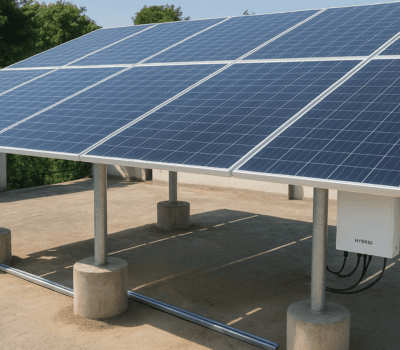
Industrial off-grid solar solutions combine the best of both worlds – off-grid and grid-tied solar systems – to provide reliable energy to industrial facilities. These systems are ideal for industries located in areas with unreliable grid power or high energy costs. The solution involves integrating solar power with backup energy storage (batteries) and, optionally, the grid, allowing industries to operate efficiently without reliance on inconsistent power sources.
How off-grid solar solutions work
An off-grid solar system works by capturing solar energy through photovoltaic (PV) panels during the day. This energy is either used directly to power industrial equipment or stored in batteries for later use. In a hybrid configuration, the system can also draw power from the grid during peak energy demands or cloudy weather, ensuring a continuous supply of electricity.
Solar PV Panels: Capture sunlight and convert it into direct current (DC) electricity.
Inverter: Converts DC electricity into alternating current (AC) to power industrial machines.
Battery Storage: Stores excess energy for use during periods of low sunlight or high demand.
Grid Backup: The system can also pull from the grid during high-demand periods, ensuring operational continuity.
Key features of off-grid solar solutions
Independence from the grid
Run selected loads on solar and batteries with less reliance on grid supply.
Battery backup
Keeps selected loads running when the grid fails, for a duration set by battery size.
Hybrid capabilities
Combine solar, batteries, grid and generators in one coordinated system.
Cost-effective
Right-sized systems avoid paying for capacity you do not use.
Sustainability
Clean, renewable generation from your own roof or land.
Benefits of industrial off-grid solar solutions
Energy security
Batteries and smart switching keep critical processes running through grid outages.
Cost savings
Lower grid purchases and less diesel-generator running time reduce operating costs.
Scalability
Systems can be designed so panels or batteries can be added as demand grows.
Reduced carbon footprint
Solar generation cuts the emissions tied to grid and diesel power.
Minimal maintenance
Periodic cleaning and annual electrical checks are usually all a well-built system needs.
Applications of off-grid solar solutions in industries
Manufacturing
Continuous energy supply is crucial in manufacturing plants, and off-grid solar systems ensure uninterrupted production.
Mining and quarrying
Remote mining operations often face power challenges, and solar systems provide a stable energy source in these locations
Agriculture
Off-grid solar systems can power irrigation pumps, refrigeration units, and other essential agricultural machinery.
Warehousing
Industrial warehouses benefit from solar energy for lighting, temperature control, and other operational needs.
Textile industry
Solar systems provide energy to power machinery, air conditioning, and lighting in textile factories.
Financial incentives and ROI
Industries investing in solar solutions often qualify for government incentives, tax rebates, and accelerated depreciation. Additionally, the return on investment (ROI) for off-grid solar systems is high, with payback periods as short as 4-6 years, depending on location, energy usage, and system size.
Components
Solar panels
PV modules convert sunlight into DC electricity; type and wattage are matched to your roof or land.
Inverter
Converts DC from the panels into AC for your loads and manages how power flows.
Battery bank
Stores surplus solar energy for evenings and outages; sized to the loads you want to back up.
Mounting structures
Galvanised or aluminium frames that hold panels at the right tilt and withstand local wind loads.
Energy management system
Decides when to use solar, battery or grid power to cut cost and protect critical loads.
Design and installation
Energy requirements assessment
We study bills, load profile and critical loads before sizing anything.
Site survey
Roof or land, shading, structure and wiring are checked on site.
System sizing
Panels, inverter and batteries are sized from your real load data.
Maintenance plan
Scheduled cleaning, inspections and performance reviews after commissioning.
FAQs
Frequently asked questions
What size of system suits a factory?
Industrial systems typically range from tens of kW to over 1 MW, depending on roof or land area, sanctioned load and daytime consumption. We size the system from your load profile and maximum demand.
Can hybrid solar protect critical processes?
Yes. We identify critical loads, such as control systems, servers, cold rooms or process lines, and design battery backup and transfer arrangements for them, rather than backing up the entire plant.
Can a hybrid system run alongside our diesel generator?
Yes. With the right controller, the system can coordinate solar, batteries, grid and DG so the generator runs less and at better load.
What tax benefits apply to commercial solar?
Businesses may be able to claim accelerated depreciation on solar assets under the Income-tax Act. Eligibility and rates change, so confirm with your chartered accountant.
What is a hybrid solar system?
A hybrid solar system combines solar panels, a hybrid inverter, battery storage and a grid connection. Solar powers your loads during the day, surplus energy charges the batteries, and the grid tops up whenever solar and batteries are not enough. When the grid fails, the inverter can switch selected loads to battery backup.
Is a hybrid solar system the same as an on-grid system?
No. A standard on-grid system has no batteries and shuts down during a power cut for safety. A hybrid system adds batteries and an inverter that can keep chosen circuits running when the grid is down, while still working with the grid the rest of the time.
Start with a conversation
Your smarter energy future starts here
Tell us about your home, facility or farm. We will recommend the right next step.