
Commercial solar
How commercial solar works
From panel to grid: how a commercial solar system turns sunlight into savings, and how net metering and monitoring fit in.
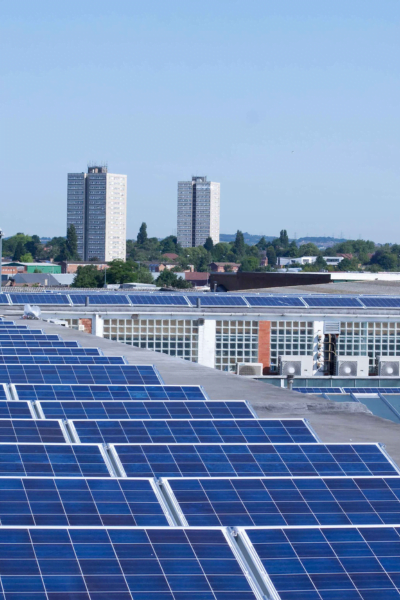
The functioning of commercial solar
A grid-connected solar power system operates for both commercial and residential sectors, with no notable distinction in usage. Energy is readily available during the day, with excess power returned to the local grid, yielding credits. Solar energy can power three-phase appliances via either three inverters, each connected to a phase, or a single three-phase inverter. Panels are typically installed on rooftops or ground-mounted structures.
Solar panels
Solar panels consist of photovoltaic (PV) cells that have the capability to convert sunlight into direct current (DC) electricity during the daytime.
Inverter
The inverter transforms the direct current (DC) electricity generated by solar panels into alternating current (AC) electricity.
Electrical panel
Subsequently, the alternating current (AC) electricity is directed to the electrical panel, where it powers all lights and appliances using solar energy.
Net meter
This apparatus is employed for measuring energy consumption. It reverses direction when your system generates more power than needed, allowing surplus power to be utilized during the night.
Local grid
In exchange for the surplus power you generate during the day, the local grid offers you credits. Your business remains connected to the grid throughout this process.
Monitoring system
We've implemented a quality monitoring system to track your power production and ensure the smooth operation of your system. Additionally, it alerts us to any potential repair issues that may arise.
FAQs
Frequently asked questions
Is hybrid solar worth it for a business?
It is a strong fit when your business uses most of its power during daylight, faces frequent outages or runs diesel generators. Solar cuts daytime grid purchases, while batteries cover critical loads and reduce generator run-time.
Can a hybrid system run alongside our diesel generator?
Yes. With the right controller, the system can coordinate solar, batteries, grid and DG so the generator runs less and at better load.
What tax benefits apply to commercial solar?
Businesses may be able to claim accelerated depreciation on solar assets under the Income-tax Act. Eligibility and rates change, so confirm with your chartered accountant.
Do you handle approvals and net metering for businesses?
Yes. We prepare the DISCOM application, technical documents and net-metering paperwork, and coordinate inspections.
What is a hybrid solar system?
A hybrid solar system combines solar panels, a hybrid inverter, battery storage and a grid connection. Solar powers your loads during the day, surplus energy charges the batteries, and the grid tops up whenever solar and batteries are not enough. When the grid fails, the inverter can switch selected loads to battery backup.
Is a hybrid solar system the same as an on-grid system?
No. A standard on-grid system has no batteries and shuts down during a power cut for safety. A hybrid system adds batteries and an inverter that can keep chosen circuits running when the grid is down, while still working with the grid the rest of the time.
Related pages
Keep exploring
Start with a conversation
Your smarter energy future starts here
Tell us about your home, facility or farm. We will recommend the right next step.